

Chapter 2: Doubt
Growing Through Grief

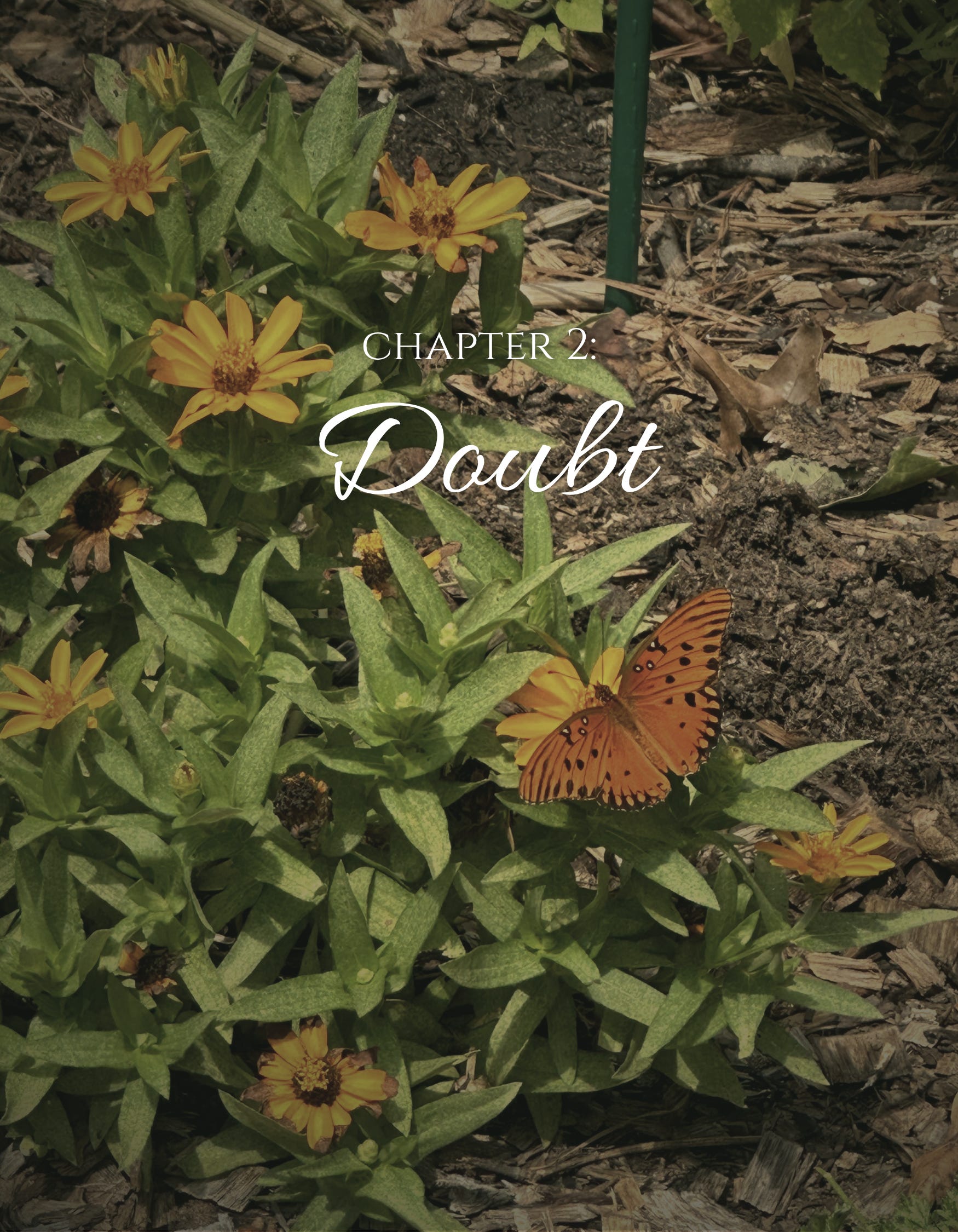
God communes with His people in gardens; we see this throughout the Bible. In the beginning He created Eden, a garden where Adam and Eve could live, experience His provision, and dwell in His presence. It was in that very garden that Eve trusted the word of the serpent, and the goodness she saw in a created thing, more than she trusted the Word of God. “So when the woman saw that the tree was good for food, and that it was a delight to the eyes” Genesis 3:6. Temptation made Eve doubt God’s goodness before sin even entered the picture. Now we live in a post-fall world. We’re surrounded by supernatural temptation, sin, and suffering. It is apart of our human experience to wrestle with doubt. Grief, in the aftermath of suffering and pain, can lead you to question God’s existence, His goodness, and even His sovereignty. If you’ve ever found yourself questioning God in the middle of pain, you’re not alone.
C.S. Lewis writes about his own experiences with doubt after the passing of his wife in, A Grief Observed. I read it shortly after my mom’s passing and it helped me to process much of what I was questioning about God. “If God’s goodness is inconsistent with hurting us, then either God is not good or there is no God: for in the only life we know He hurts us beyond our worst fears and beyond all we can imagine.”
He is painting a centuries old debate, if God is real, and he is good, why do we suffer so much? I would spend many mornings in my garden, feeling so heavy with the unbearable pain of having lost so much. I communed with God. As it began to flourish and take shape, as I slowed down to take in all of creation around me, I began to see how symbiotic and perfect each living thing helped another. A perfect system intricately designed, and my garden was just a small picture of it. When you look at all of creation around you, you know, there has to be a God.
“For what can be known about God is plain to them, because God has shown it to them. For his invisible attributes, namely, his eternal power and divine nature, have been clearly perceived, ever since the creation of the world, in the things that have been made. So they are without excuse.” Romans 1:19-20 My mom was a very wise woman, with incredible, immeasurable faith. She would often say to me growing up that you know there is a God when you look at creation and I was finding out that was true, I just needed to slow down to notice it.
When she became sick there were a couple worship songs she would play nonstop. Goodness of God by CeCe Winans was the first. My mom’s faith never wavered, even after enduring so much physical, and I’m sure, emotional suffering. You would have never known what she was going through with how she carried herself. She spoke about God’s goodness and gratitude often. Her faith was awe-inspiring as I had just come back to God and had no idea how to grow such formidable belief. Her passing surely made me question God’s goodness. And with each loss we suffered I began to question even more.
C.S. Lewis also had this same wrestle, “The more we believe that God hurts only to heal, the less we can believe that there is any use in begging for tenderness. A cruel man might be bribed- might grow tired of his vile sport-might have a temporary fit of mercy, as alcoholics have fits of sobriety. But suppose that what you are up against is a surgeon whose intentions are wholly good. The kinder and more conscientious he is, the more inexorably he will go on cutting. If he yielded to your entreaties, if he stopped before the operation was complete, all the pain up to that point would have been useless. But is it credible that such extremities of torture should be necessary for us? Well, take your choice. The tortures occur. If they are unnecessary, then there is no God or a bad one. If there is a good God, then these tortures are necessary. For no even moderately good Being could possibly inflict or permit them if they weren’t.”
Even in the confirmation of God’s existence from my time in the garden, the question still remained, how can a good God allow us to suffer? Well if He were cruel, wouldn’t He have given up by now? But if His intentions are wholly good, the pain has a higher purpose, and He uses it in ways we don’t quite understand yet. This idea of goodness I often tried to define by my own limited human knowledge and capacity, as most of us do, but C.S. Lewis came to the conclusion that it’s not that black and white.
There’s a phrase people use all the time, God will never put more on you than you can bear. That’s not the full truth. The pain from grief is often times more than you can bear…on your own. That’s why Philippians 4:13 reminds us, “I can do all things through Christ who strengthens me” It’s about dependence on God in the face of pain, grief, and suffering to get through it, to find contentment. A few verses up, Paul is giving encouragement to the Philippians, and he’s writing this while being imprisoned in Rome. He tells the church in Philippi to rejoice in the Lord in every circumstance, he then tells them how to tackle their anxieties to experience the peace of God, and in verse 8 he tells them, “Fix your thoughts on what is true, and honorable, and right, and pure, and lovely, and admirable. Think about things that are excellent and worthy of praise.” Paul, who had lived a life of suffering since he encountered Jesus on the road to Damascus, was not only able to find contentment through the Lord, but also send encouragement to others who were suffering as well? How did he crack the code? It’s clear, if we keep our hearts and minds on all that God has done, everything that is right in our lives and the world, everything that is…good…then surely we’ll see the goodness of God.
Many of us come from families that tell us we shouldn’t question God. But the opposite of faith is unbelief, not doubt. Some argue that doubt is necessary for faith to even exist. Because if we knew with all certainty 100% of the time all of the truths about God and who He is, we wouldn’t need to believe. It’s more important what you do with your doubts. David writing the Psalms is the perfect example…you take them to God. My mom began to say “I’m waiting on the Lord,” over and over again in the last 4 months of her life. It was the answer to every question, and it’s what David ends Psalm 27 with, a Psalm about his anxiety and his suffering, as he is fleeing his enemies. Throughout the Psalm, David is continuously encouraged by “delighting in the Lord’s perfections” (27:4) He worships, he prays, and finally he says, “I believe that I shall look upon the goodness of the Lord in the land of the living! Wait for the Lord, be strong, and let your heart take courage; wait for the Lord!” Psalm 27:13-14
One of the last moments I remember her singing the Goodness of God, my aunts and I were gathered in the room she lived in at my home for a short time while we took care of her. I can remember her voice as she sang, “all my life you have been faithful, all my life you have been so so good, with every breath that I am able, I will sing of the goodness of God.” And she broke into tears, and we all wept and surrounded her with love and hugs. Maybe she knew she had reached the end, she was waiting on the Lord. But even in the end, she always remembered his goodness. And even in my doubt, her faith reminded me of what was still true.
Join me next week as I explore having full trust in God, after insurmountable heartbreak- it’s easier said than done